


Fully Stop RV Black Tank Smells & Gray Too!
Black and Gray tanks are built as ‘closed systems’ or holding tanks, you should never smell a holding tank unless you open up access to the system such as when you connect your dump hose or when you are flushing the toilet you open it for a second you expect to smell the tank. Outside of that, you should not smell it unless your system has a leak or gap that is allowing tank smells to escape the 'closed system' and enter into your rig you . Here is how to stop RV black tank smell identify the leak/gap and seal it. Luckily there are only a few places to check for those gaps. The most common culprit is also cheaper to fix than you might think too!
Find the gap. Seal the system. Stop smelling the tanks inside the rig.

Face it, the tanks are going to smell, you are filling them with waste, gray tanks will eventually get grease & bits of food from washing dishes and grow nasty things that turn into a nasty stinky mess too, but just because the tank smells does not mean you have to smell the tank.
How to Stop RV Black Tank Smells from entering your RV: starting with the most common area to the least so you can check each:
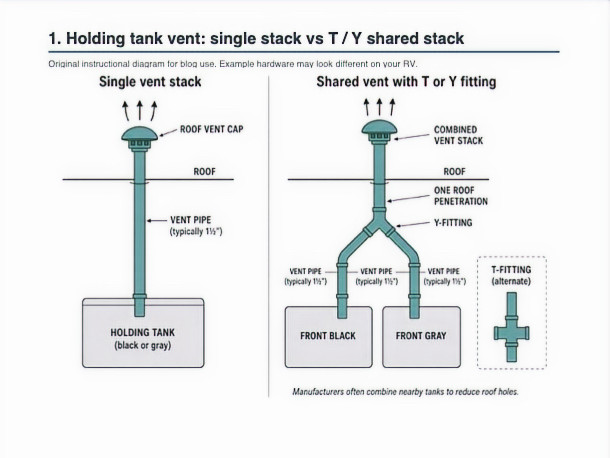
Vent Pipe: this pipe connects the tank to the roof allowing air to move and water to flow into and out of the tank, you need this pipe, but if it’s not sealed to the roof it will allow smelly air into the RV: this is far more common root cause for smelling your tanks than most people realize as most RV manufacturers do not seal this pipe where it meets the roof. If you notice smells when you add water, empty or flush your tanks to dump them this is likely why, during each tank maintenance you are moving or adding water in the tank displacing the smelly tank air pushing it into the vent pipe, that pushing goes up the vent pipe to the outside and unfortunately gets pushed through any gap between the vent pipe and the roof, especially when you are running fans or the AC which is circulating air. Often these smells enter the attic area and then permeating throughout any hairline gaps in the walls, ceiling, A/C ducting, etc. Depending on your RV model you may have more than one vent pipe, or just one vent pipe that is connected to both the black and gray tanks via a T or Y pipe (see example photo below).
Fully Seal the Vent Pipe to the Roof to stop the transfer of stinky tank gas: DIY steps, on the roof bring both a flat head and Phillips screwdriver and your phone camera, locate your vent pipe(s) and remove the Vent cap(s) (attached usually with a few screws), check to see if there is a gap, even a hairline gap, between the pipe and roof, if there is you can seal it. Also check the inside of the pipe for obstructions (leaves, spider webs, etc.), in our pipe vent we found a piece of the original roof material that had broken off during the build and lodged in the pipe where they cut the pipe vent hole in the roof. This piece could not be retrieved so we pushed it down with a garden hose and it exited the tank at the next flush. The vent pipe diameter is usually about 1″ to 2⅜″ inches while the tank dump pipe is about 3” which is why it could flush out. You can also clean the pipe with a ½ inch garden hose, nozzle sprayer and water; just make sure the tank is empty enough for you to add the water to it during this cleaning of the vent pipe. For sealing the gap there are many products you can use as long as they will adhere to both the plastic pipe and whatever material your roof is made of, we used a can of Loctite expanding foam from Amazon, you can get this at a local hardware store too, and other outside sealants would work, you just want to cover and seal the gap. Do not expect this fix to last forever though, the constant earthquake when driving the RV will eventually shake it lose, the smells will return and you will just reseal it. The great news is the DIY fix is less than $25 (see our own vent photos below). After this one fix we have dumped our tanks 9 times, moved to 5 sites across 1,200 miles and still not one smell! If you prefer a roof-rated sealant instead of foam, use what is approved for your roof (often self-leveling lap sealant around the flashing).


Toilet seals may need replacing or maintenance if you are smelling stink around the toilet area, there are 3 things to check.
The Toilet Ball Seal sits in the toilet bowl holding some water in the bowl which also prevents tank smells from coming up the toilet pipe, if that seal is bad you may see air to bubbling up into it, it could be dirty or need to be re-lubricated, you can clean it with a mild cleaner and brush, apply toilet seal lubricant and reinstall. If the rubber seal is worn down or cracked replace it with a new seal such as this one if it fits your toilet and lubricate it. Or when this seal is degrading just a bit the bowl will not hold water for long, basically a slow leak, anytime water exits stinky tank air can come in.
Toilet lower Flange seal is leaking toilet water at the base of the toilet bowl or floor depending on the type of toilet you have (which is pretty gross as that could be sewage water coming from the inside of the toilet someone just used) quickly replace the flange, here is one for a Dometic 300/310/320!!
Toilet Flushing: yes this is normal, when you flush the toilet you are opening the closed system letting smells escape, so flush fast!
For the Gray Tank smells: Gray tanks can stink but it is also a closed system, you should never smell it inside the RV, there are two components to look at. First the P Trap prevents odors from escaping the sink drains, the second is the AAV which allows ventilation so water can get into the tank and this also prevents odors from coming up the pipe and getting into your RV. If you are smelling stinky odors when you open the cabinet under the sink try these, Here is an example of a P-Trap and AAV in an RV, your RV may be similiar but not exactly the same.

P-Trap: look at the pipe below the P Trap area first to see if water or air is leaking, no matter how slowly, if it is then fix that leak. If it is dry, try the soap test to check for air escaping to locate a slow leak. To do this either spray the pipe joints where they are connected with some soapy water using a spray bottle to create bubbles (shake it well), or spray foam bathroom cleaner on it (like Dow etc) and then run the water at the sink, you will either see air escaping through the soap bubbles at a seam or you won't.
If there is water or air leaking but you still smell a stink then you might have a faulty Air Admittance Valve (AAV), this does not happen often but it can fail. The AAV seals off one specific opening in your plumbing allowing air into the system so that water drains properly which also prevents tank gas from escaping back into the RV. You can replace the AAV easily, it just unscrews, the new one screws back in, for a strong seal wrap the threads with Teflon tape before screwing it in. Here is an example AAV valve for RV's from JB products, be sure to measure your pipe diameter or refer to your RV manufacturer for size when you order.
Leak in your dump hose/bad sewer connection: if you notice smells outside while dumping you may have a small leak, pin hole, etc. in your dump hose or if the sewer inlet connection is not tight you will smell odors escaping from that. The best fix is to buy a new hose and/or sewer connector. We have found there are a few different sewer inlet pipe types in parks as we travel (threaded, not threaded, stripped threads etc.), so we have a couple of different types of sewer inlet connectors on hand and use the one that work best for that connection. Here are a few types to consider:
Cracked tank/pipe: this is the costliest and least common issue, but if the tank or the pipe’s that is connect to it underneath the RV cracks you would smell the odors, and you might see the belly bulge as it is filling with tank waste. Hopefully this is not the issue as you might have to pay a professional to have it fixed, some people have fixed it using DIY methods, if this happens to you search for how to fix it on the web.
FAQ:
Do I even need tank Chemicals? Should I have a professional Tank Cleaning? Now that you know how to prevent odors from getting into your RV you are probably wondering if you really need to use those chemicals in your tanks? After all the majority of the videos and articles about stopping black and gray tank smells often focus on selling you ongoing chemical treatments as the solution that just mask the odor but never fully stop you from smelling it. Or they tell you to do an expensive Tank Cleaning which only lasts until you use the RV then it starts all over again. Neither of these solutions addresses the actual root case or reason you are ‘smelling it’ at all. That said we do still use chemicals in our black tank because they breakdown waste and toilet paper so that most of it exits easier during flushing; and we still do a professional tank cleaning every 6 months since we live in it full time, this is routine maintenance, like spring cleaning the refrigerator, etc. Maintenance is important for the longevity of everything you own, and for your health too. I'm of the opinion that those holding tanks are going to become very toxic over time if they are never cleaned and any leak that occurs in the future will include the bacteria, mold and mildew that has made the tank it's home in between deep cleanings, now that is just my opinion, you do you!
I hope you found this information on how to stop RV black tank smell helpful. Since there are so many different RV and toilet models I am not going to give you a step by step for them all, these tips should be enough to get you started. Other ‘closed systems’ in your RV are the Propane and Water systems. I have no tips for Propane, that should be handled by a certified tech. I do have tips for locating water leaks that might help you, especially if your water pump keeps turning on and off when you are not even running the water (which means you have a leak), scroll down for the article or click here for the video steps.
Let's all live stink free!!
Note: some links may be affiliate links where I receive a small amount from the seller of a product if you buy it, this does not increase your price for the product.


Comments